SUBPRIME AND CRAMER FOR THE RECORD-
Cramer two weeks ago in mid July....
Cramer now....
I think he gives a pretty accurate picture of the two-faced nature of a lot of these Wall Street guys....they leverage up irresponsibly, then when they wreck the system they want Mommy (or Bernanke) to bail them out. The Colbert followup is hilarious. As it stands, I am currently short an ACS $50 put (that is now in the money) and am at a loss....hope to get "put" the stock, as the potential buyout price on the company is above $60/share (30% premium to current price). Also am long some Broadridge stock and Discover Financial, both hedged with covered calls. Idiots are hoping the Fed will add liquidity to the market so they can get big market rallies....not "save the economy".... sometimes its just annoying to watch the market.
Friday, August 10, 2007

Friday, June 15, 2007
The buyout/LBO-boom has just witnessed its first major casualty....
Ronco, Maker of the Veg-O-Matic, Files for Bankruptcy (Update2)
2007-06-15 13:05 (New York)
(Adds sale of company in third paragraph.)
By Jeff St.Onge
June 15 (Bloomberg) -- Ronco Corp., maker of the Veg-O-Matic
vegetable slicer and Pocket Fisherman, filed for bankruptcy two
years after founder and television pitchman Ron Popeil sold the
company.
Ronco, which marketed products as perfect for ``grads and
dads,'' sought protection from creditors owed more than $32.7
million. It listed $13.9 million in assets in papers filed
yesterday in U.S. bankruptcy court in Woodland Hills, California.
A sale of Ronco ``in the coming weeks is the best and most
viable mechanism for preserving'' the company's value, Chief
Executive Officer John S. Reiland said in the bankruptcy filing.
Reiland said Ronco will be sold through a court-supervised
auction and already has a potential buyer.
Popeil, 72, started the Chatsworth, California-based company
in 1958 and became a household name by hawking products in late-
night television ads. He was known for infomercials selling his
products, and got his start pitching his father's Veg-O-Matic
manual food processor with the phrase: ``It slices! It dices!''
Ronco was sold by Popeil to a holding company, Fi-Tek VII,
in June 2005, according to court papers. The buyer kept the Ronco
name and the right to purchase products Popeil invents before
they are offered elsewhere. He continues to work for Ronco as a
consultant and spokesman.
`But wait, there's more'
Popeil Inventions, owed more than $11.7 million, and other
companies owned by Popeil are listed in court papers as Ronco's
largest creditors. His inventions include a machine that
scrambles eggs inside the shell, a food dehydrator, an automatic
pasta-maker and a spray to cover bald spots on people's heads.
Among the company's best-selling gadgets is the Pocket
Fisherman, a compact rod and reel.
Popeil is listed as an inventor on more than two dozen U.S.
patents, according to the U.S. Patent and Trademark Office. His
fast-paced TV ads added phrases to the lexicon, such as ``But
wait, there's more'' and ``four easy payments.''
Popeil placed Ronco under bankruptcy court protection in
February 1984, and the company stopped doing business until he
resurrected the business with a former company salesman.
Fi-Tek VII's buyout in 2005 left Ronco with about $250,000
cash, Reiland said in court papers. The cash ``problem was
compounded by the fact that Ronco was entering the period where
it required significant working capital in order to acquire
inventory for the busy holiday season,'' he said.
`Wow, That's Terrific Bass!'
Stacia Neeley, Ronco's bankruptcy lawyer, didn't return a
call seeking comment. Popeil didn't return a message left with
his assistant.
In August, Ronco fired President and Chief Executive Officer
Richard Allen. He was replaced by Reiland, who first joined the
company in June 2005, according to court papers.
Ronco shares, which peaked at $2.60 in June 2006, almost
doubled, jumping 6 cents to 13 cents at 9:30 a.m. in over-the-
counter Bulletin Board trading.
Ronco's television ads were so familiar to viewers that they
were spoofed by comedian Dan Aykroyd in a famous 1976 sketch on
the television program ``Saturday Night Live.'' In the sketch,
Aykroyd advertises the ``Super Bass-O-Matic '76'' by ``Rovco,'' a
blender that turns a whole fish into a brown liquid, which is
then drunk by Laraine Newman, who co-starred in the segment.
``Wow, that's terrific bass!'' she says.
The case is In re Ronco Corp., 07-12000, U.S. Bankruptcy
Court for the Central District of California (San Fernando
Valley).
--With reporting by Anthony Aarons in London, Susan Decker in
Washington and Bob Van Voris in New York. Editor: Rovella
Monday, March 05, 2007
DGX-LH long-short trade closed out
The chart indicates the approximate gain, although the ride has been a bit more volatile than I had expected when i got into the trade. The original thesis was that DGX was 25% undervalued versus Labcorp, but Quest lost a second major contract (following UNH loss) that made me question their aggressiveness in their core lab business. As originally predicted, Quest Diagnostics picked its skirt up from around its ankles and got back to work, with the recent announcement that LH would no longer be serving as Aetna's in-network lab provider.
This helps Quest marginally, but more importantly signals the potential for a major price war, which could hurt both companies longer term (fighting for market share, cutting each others throats). Quest will probably still be a good long-term investment at these levels, but I have decided to speculate a bit and close out both sides of the trade. Net-net, I exited DGX around a 1/2% loss, and LH at a 7.5% gain. I'm sure the trade levels will continue to collapse, but will look to re-enter DGX within the next month or two hopefully.

Sunday, February 25, 2007
Another Day, Another buyout... for those not keeping track at home, Florida Rock and Hydril have both been bought out at massive premiums versus my recommendations (to buy) that were made within the past six months in this blog. FRK is trading at $68 (up 58% from my $43 reco. price in Oct. 2006 and 78% from my buy-in price) and HYDL is trading at $95 (up 86% from my $51 buy-in price). They have been bought at heavy premiums above what the public market value would have reached, but reflective of the control premium that a private owner would be willing to pay to acquire these high quality franchises. Unfortunately, I unloaded most of my stock in both names after I had made 25% and 41% in the respective names. I have had more annoying problems in my life than selling at a 40% gain within a one month period though!
I continue to like $2-5Bln market cap companies, but have lately been looking at some slightly larger entities that also represent high quality businesses with strong brands and franchise quality. Several of these names are trading just above levels where I would consider them to be cheap. For instance, SAIC(federal IT/professional-services contractor-$18.50) and MRH(Bermuda reinsurance-$17.70) are names that I like. SAIC's main business risk is political, in the form of potential Democratic meddling with Federal outsourcing.... MRH's is hurricanes and nonsense like Florida's restructuring of its excess-of-loss reinsurance pricing.
In spite of these risks, MRH is increasing its book value by 15-20%/year and trades at 1.1x book value, with one of the best underwriters as its CEO and a more conservative risk policy (which is why book value isnt going up even faster). SAIC is not "cheap" per se, on an earnings basis, given its nearly 20x forward earnings, but this is one of those beauties that earns more in free-cashflow than it reports in earnings, due to the amortization of fixed-contract costs that are incurred up-front. Given that nearly 22,000 of their 45,000 employees have high-level security clearances (tough to acquire), this gives them a reasonable barrier to entry. On a FCF basis SAI earns above a 5% yield and should improve this figure now that it is a public company. On both companies I have bought a small amount of stock and sold out of the money calls. In addition, I have sold $17.50 puts going out to April for a 3% implied yield-to-put (22% annualized return, assuming I am not put any stock). If either SAI/MRH falls below $17.50 I would be okay owning these entities for the long-term, based on my current view of management and the companies.
I do not think either of these companies will be acquired by private equity, although SAI would be extremely attractive in an LBO if it were to fall much below $17.50....so I am not expecting a grand slam like FRK/HYDL to occur. The market appears frothy with too many things hitting 52 week highs, companies that people were shunning back in July. (PS- If I am not "put" any MRH/SAI, would look to roll and sell forward additional contracts, although MRH should carry a huge premium through the summer if you think hurricane season migh pick up).
Wednesday, February 07, 2007
Site of the Month- Check out http://valuediscipline.blogspot.com/
They had a pretty good writeup several days ago on MMM. From what I can tell, this company generates nearly $4.5Bln in normalized cashflow from operations, approximately $3.5Bln actual cashflow (due to working capital expenses) and nets out to $2.5Bln actual free cashflow per year. This assumes continued R&D and growth expenditures, however on lower growth assumptions this company trades at 16x free-cashflow in a low growth scenario, for a 6.25% free cashflow yield. While not the sexiest yield in the world, people have historically paid a lot more for this company's earnings...which have continued to increase in the face of a flattish/declining stock price over the past few years. The chart below tracks the company's stock price (white line) vs. its P/E (green line). MMM is under-levered ("AA" credit rating) and appears to be somewhat cheap on an absolute basis, but very cheap on a relative basis (versus its historical trading range). It is difficult to gauge competitive threats and how much LCD pricing will hurt some of their film divisions, so I am just buying a half position and watching it. This is more of a long-term IRA stock.

Friday, January 12, 2007
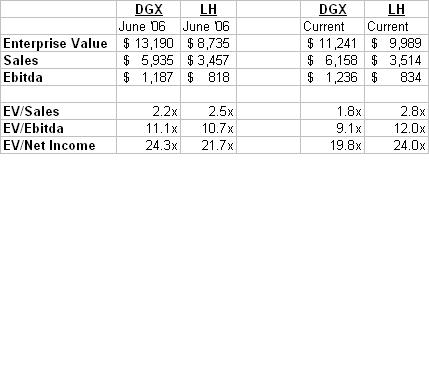
Quest For The Championship? Although the Bears playoff game on Sunday is probably the Quest most sane people are focused on, I have noticed a disturbing discrepancy between Quest Diagnostics(DGX) and Laboratory Corp.(LH) valuations. The discrepancy has arisen from LH bidding aggressively on DGX contracts. Both companies run diagnostic lab/testing facilities and are the largest players in their industry. Vital stats are below. 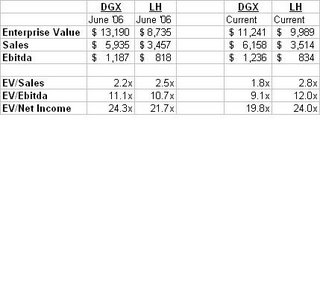
For similar businesses in a commoditized industry (in which DGX is the leader and has historically outperformed LH in) Laboratory Corp is trading at a higher sales multiple (55% premium) and a higher Ebitda multiple (33%). The fact that Laboratory Corp is willing to sacrifice margins and risk its own book of business to engage in a price war does not appear to be priced into the market. Given that Quest is likely to engage in similar guerilla-type market-share theft, I believe a short of Laboratory Corp. makes sense. At the same time, I like the overall industry and believe Quest Diagnostics is trading at a 'slighly' compelling valuation that could be attractive to a private equity buyer (particularly if it fell any further.
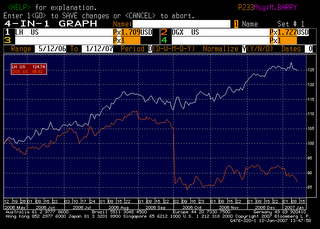
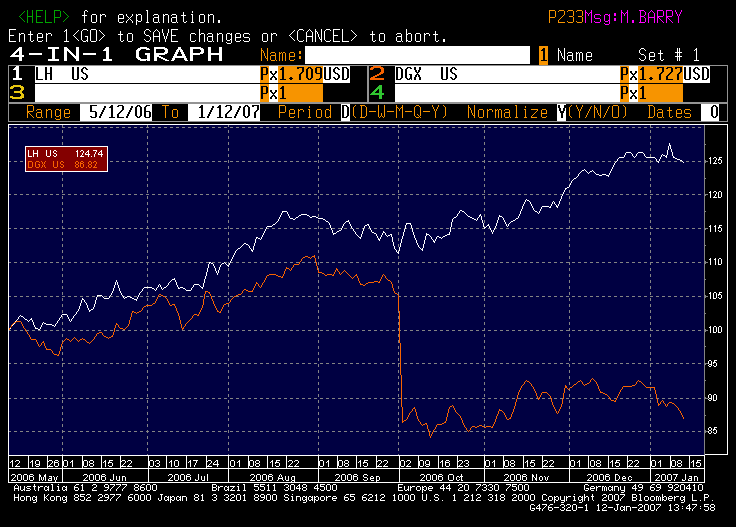
As such, I am recommending a short of LH ($73) and a buy of DGX ($50.10) and have executed this trade for myself and my Oceans-7 account. I am considering selling LH $75 calls and/or buying longer-dated $65 LH puts. Below is a historical spread comparison between the two companies. Note that since 1995, DGX has significantly outperformed LH (in spite of recent drop), which tends to indicate that DGX's near-term underperformance may revert towards the historical average. I have not done any mean-regression analysis, apart from what I can accomplish by eye-balling the chart. This looks like a winner though, as I think the market is reading too much into DGX's loss of a contract with United Healthcare (which accounted for 7% of DGX revenue). The thesis behind the trade idea is, if DGX is in trouble....LH will be too in the not-too-distant future. This has been true for both companies historically.
For similar businesses in a commoditized industry (in which DGX is the leader and has historically outperformed LH in) Laboratory Corp is trading at a higher sales multiple (55% premium) and a higher Ebitda multiple (33%). The fact that Laboratory Corp is willing to sacrifice margins and risk its own book of business to engage in a price war does not appear to be priced into the market. Given that Quest is likely to engage in similar guerilla-type market-share theft, I believe a short of Laboratory Corp. makes sense. At the same time, I like the overall industry and believe Quest Diagnostics is trading at a 'slighly' compelling valuation that could be attractive to a private equity buyer (particularly if it fell any further.
As such, I am recommending a short of LH ($73) and a buy of DGX ($50.10) and have executed this trade for myself and my Oceans-7 account. I am considering selling LH $75 calls and/or buying longer-dated $65 LH puts. Below is a historical spread comparison between the two companies. Note that since 1995, DGX has significantly outperformed LH (in spite of recent drop), which tends to indicate that DGX's near-term underperformance may revert towards the historical average. I have not done any mean-regression analysis, apart from what I can accomplish by eye-balling the chart. This looks like a winner though, as I think the market is reading too much into DGX's loss of a contract with United Healthcare (which accounted for 7% of DGX revenue). The thesis behind the trade idea is, if DGX is in trouble....LH will be too in the not-too-distant future. This has been true for both companies historically.
Tuesday, November 21, 2006
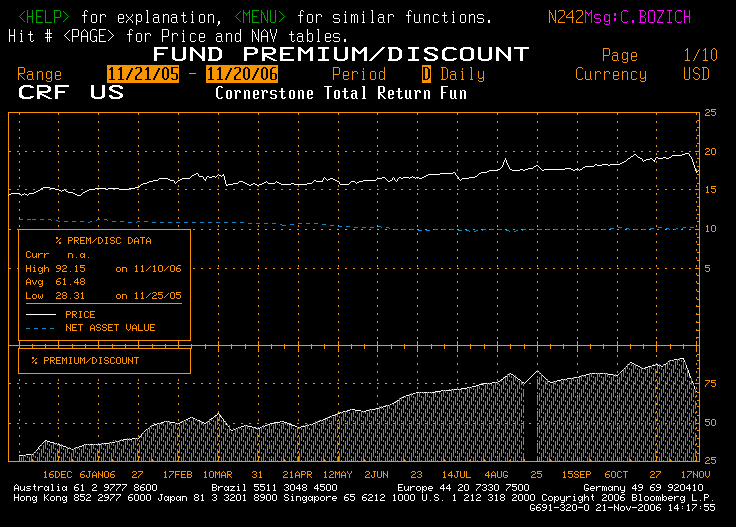
Con Artists at Cornerstone (CRF)- Of course the best short idea in the universe did not have shares to borrow at $19.39!!!!
You might be interested in checking out CRF(see also CLM), a closed end fund that trades at 170% of its NAV (was 190% recently before a drop). It owns a bunch of Dow stocks as its top holdings (nothing special) and is only 85% invested. The kicker is that the fund carries a current yield of +11.5%, which equates to paying out nearly 21% of its NAV. Clearly this is not the modus operandi of a "going concern" closed end fund, however the meat of the story appears to originate with the fund's largest holder Ron Olin and his relationship with Doliver Capital and a firm called "Deep Discount Advisory"....oh the irony! My best guess is that these firms are engaged in selling shares of CRF to small investors in cash/retirement type accounts where they cannot be margined. There is a distinct lack of large holders, with the thirteen largest stockholders (behind Ronald Olin and related entities) holding a mere 2% of the outstanding shares. Thus, there are no shares to borrow for a short position against this overvalued asset, which is a shame since there appears to be an obvious incentive for Mr. Olin to market his overpriced stock to unwitting investors, who are no-doubt focused on the current yield of the fund (rather than the all-important NAV).
This essentially amounts to selling people a one dollar bill for $2, not exactly a fair trade...especially when you consider the distinct lack of special assets in the fund. Note, being 15% invested in cash has not stopped the fund manager from charging fees on the assets under management. To put it another way, in the chart below, figure that the "white line" should be trading somewhere south of the "blue line"...which implies a 40% plus drop is in the cards for this turkey sometime in the near future (assuming the Dow Jones average does not double...in which case it could remain flat!)
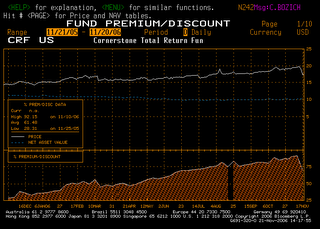
Thought given your position this might be worth passing along, as this would be an excellent case where short sellers would be able to save future investors from "getting their faces ripped off" by Mr. Olin. Note, I am short zero shares due to the clever scheme that has been set up here. (PS- note that CRF is a long-dated fund that traded at a discount prior to the 2000's, but since undergoing manipulative marketing it has been on a rollercoaster ride)
You might be interested in checking out CRF(see also CLM), a closed end fund that trades at 170% of its NAV (was 190% recently before a drop). It owns a bunch of Dow stocks as its top holdings (nothing special) and is only 85% invested. The kicker is that the fund carries a current yield of +11.5%, which equates to paying out nearly 21% of its NAV. Clearly this is not the modus operandi of a "going concern" closed end fund, however the meat of the story appears to originate with the fund's largest holder Ron Olin and his relationship with Doliver Capital and a firm called "Deep Discount Advisory"....oh the irony! My best guess is that these firms are engaged in selling shares of CRF to small investors in cash/retirement type accounts where they cannot be margined. There is a distinct lack of large holders, with the thirteen largest stockholders (behind Ronald Olin and related entities) holding a mere 2% of the outstanding shares. Thus, there are no shares to borrow for a short position against this overvalued asset, which is a shame since there appears to be an obvious incentive for Mr. Olin to market his overpriced stock to unwitting investors, who are no-doubt focused on the current yield of the fund (rather than the all-important NAV).
This essentially amounts to selling people a one dollar bill for $2, not exactly a fair trade...especially when you consider the distinct lack of special assets in the fund. Note, being 15% invested in cash has not stopped the fund manager from charging fees on the assets under management. To put it another way, in the chart below, figure that the "white line" should be trading somewhere south of the "blue line"...which implies a 40% plus drop is in the cards for this turkey sometime in the near future (assuming the Dow Jones average does not double...in which case it could remain flat!)
Thought given your position this might be worth passing along, as this would be an excellent case where short sellers would be able to save future investors from "getting their faces ripped off" by Mr. Olin. Note, I am short zero shares due to the clever scheme that has been set up here. (PS- note that CRF is a long-dated fund that traded at a discount prior to the 2000's, but since undergoing manipulative marketing it has been on a rollercoaster ride)
Friday, November 17, 2006
Best Investment Idea of the Year- Overweight recommendation on Chipotle Gift-Certificate Cards (literally)
Sell your house, take out a second mortgage, this is the idea you've been waiting for..... For a pittance of a sum, you can buy a $25 Chipotle gift-card and receive a coupon for a free burrito. Based upon an implied value of $5.50 per burrito, this works out to a 22% return on investment. While the coupon must be used before year-end, estimating by my current rate of Chipotle consumption...that would be good for at least 10-20 trips before year-end (and the gift cards remain valid for at least another year). Thus, the rate of return on your investment increases substantially when you discount the fact that you would have eaten at Chipotle a couple hundred times next year, whether you had bought the gift certificates or not. Essentially, that money is a future "sunk cost", so taking advantage of the gift certificate is equivalent to getting free money.
Sell your house, take out a second mortgage, this is the idea you've been waiting for..... For a pittance of a sum, you can buy a $25 Chipotle gift-card and receive a coupon for a free burrito. Based upon an implied value of $5.50 per burrito, this works out to a 22% return on investment. While the coupon must be used before year-end, estimating by my current rate of Chipotle consumption...that would be good for at least 10-20 trips before year-end (and the gift cards remain valid for at least another year). Thus, the rate of return on your investment increases substantially when you discount the fact that you would have eaten at Chipotle a couple hundred times next year, whether you had bought the gift certificates or not. Essentially, that money is a future "sunk cost", so taking advantage of the gift certificate is equivalent to getting free money.
Friday, November 10, 2006
Wednesday, November 08, 2006
Hydril Update- I couldn't take it anymore and sold my Hydril at $69.30, as it continues to rally out of control. Nearly a 40% gain from $50.50 entry price. Too bad I never got to my full position, because it rallied so quickly. Next time I get to buy this good of a company on the cheap (while the cycle is still in their favor), will put on a full-position in the name right away. Meanwhile, my hold-discipline on FRK is not paying off yet, as the stock has fallen off of the $46 high from a week or so ago. Not too worried, have been reading that the Cemex bid for Rinker Group would need to climb nearly 10% for certain fund managers to consider accepting that offer....which would bode extremely well for the prospects of the less-expensive Florida Rock.

QOTD from Will Rogers- "A holding company is a thing where you hand an accomplice the goods while the policeman searches you. "

QOTD from Will Rogers- "A holding company is a thing where you hand an accomplice the goods while the policeman searches you. "
Tuesday, November 07, 2006
Monday, November 06, 2006
Bubblin' Crude- HYDL- Hydril Corp
Ben Graham (1976-FAJ)- "The stock market resembles a huge laundry in which institutions take in large blocks of each other's washing...without true rhyme or reason."
The spasmic market decimated Hydril's stock price following the decline in oil and nat. gas prices. I do not believe that I have any crystal ball or special edge in forecasting future oil prices. However, as seen by all of the johnny-come-lately hurricane forecasters predicting another "storm of the century" in the year AFTER Katrina hit, it appears that many "expert forecasters" offer much ado about nothing. After seeing Berkshire's reinsurance profits rise 5-fold, I have a bold prediction myself(with a 99% certainty) that Buffett will have a very funny, smart-ass quip in his upcoming 2006 annual report about the various weather experts and forecast models!
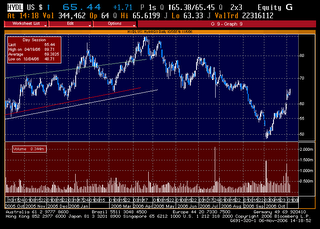
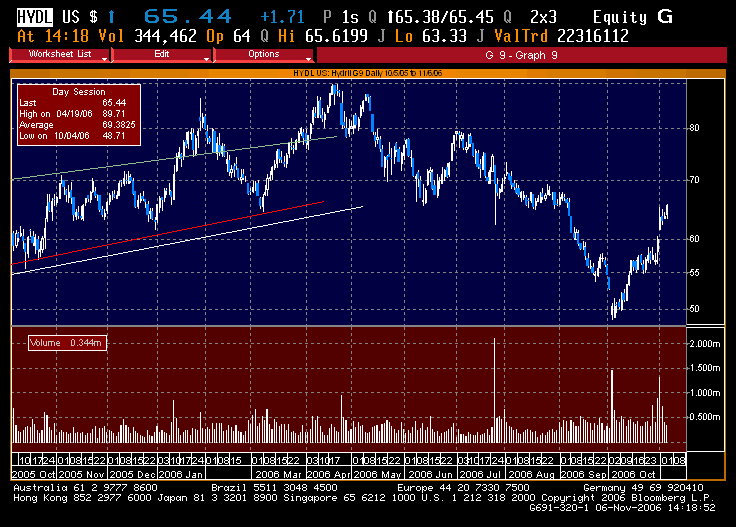
Onto the subject at hand, am up significantly on HYDL. Originally wrote up at $55/share, but the stock fell so fast at the beginning of October I wound up buying a half position at $50.50. Following an awesome wedding for my brother in Austin last week, I was incommunicado for the last 10 points of stock movement (luckily, as it did not tempt my fate to sell my shares). HYDL earnings will likely be limited in the near-term, as excess drill-pipe capacity needs to be worked off by E&P companies. At $50/share, HYDL traded at 7x Ebitda with a huge order backlog and a strong management team ( I worked with them as a private lender at Principal, top shelf guys...even when the market was not overly favorable towards them). Am not buying any more here and debating whether to sell some (just so I can say I made 30% within a month :) ). The RSI on this was near 20 and way oversold in early October and is now nearly 70 (overbought).
In other news, notable LBO/buyouts that have occurred today include SWFT (Swift Transport- Walmart trucking co.) and ELK (Elkcorp exploring strategic actions and company bid....stock is up 23%), ELK was a name I had ordered up annual reports on due to its valuation and the fact that all of my neighbors get their roofs replaced every 5-7 years unnecessarily (insurance money). Interestingly, SWFT first peaked my interest more than a year ago based on the insider buying by their CEO at $22/share. Their CEO is back for the rest of the company with a $29/share bid that may increase. No position in either of these companies unfortunately.
Ben Graham (1976-FAJ)- "The stock market resembles a huge laundry in which institutions take in large blocks of each other's washing...without true rhyme or reason."
The spasmic market decimated Hydril's stock price following the decline in oil and nat. gas prices. I do not believe that I have any crystal ball or special edge in forecasting future oil prices. However, as seen by all of the johnny-come-lately hurricane forecasters predicting another "storm of the century" in the year AFTER Katrina hit, it appears that many "expert forecasters" offer much ado about nothing. After seeing Berkshire's reinsurance profits rise 5-fold, I have a bold prediction myself(with a 99% certainty) that Buffett will have a very funny, smart-ass quip in his upcoming 2006 annual report about the various weather experts and forecast models!
Onto the subject at hand, am up significantly on HYDL. Originally wrote up at $55/share, but the stock fell so fast at the beginning of October I wound up buying a half position at $50.50. Following an awesome wedding for my brother in Austin last week, I was incommunicado for the last 10 points of stock movement (luckily, as it did not tempt my fate to sell my shares). HYDL earnings will likely be limited in the near-term, as excess drill-pipe capacity needs to be worked off by E&P companies. At $50/share, HYDL traded at 7x Ebitda with a huge order backlog and a strong management team ( I worked with them as a private lender at Principal, top shelf guys...even when the market was not overly favorable towards them). Am not buying any more here and debating whether to sell some (just so I can say I made 30% within a month :) ). The RSI on this was near 20 and way oversold in early October and is now nearly 70 (overbought).
In other news, notable LBO/buyouts that have occurred today include SWFT (Swift Transport- Walmart trucking co.) and ELK (Elkcorp exploring strategic actions and company bid....stock is up 23%), ELK was a name I had ordered up annual reports on due to its valuation and the fact that all of my neighbors get their roofs replaced every 5-7 years unnecessarily (insurance money). Interestingly, SWFT first peaked my interest more than a year ago based on the insider buying by their CEO at $22/share. Their CEO is back for the rest of the company with a $29/share bid that may increase. No position in either of these companies unfortunately.
Monday, October 30, 2006
Where is the LUV???
G. Gerswhin-" Life is a lot like jazz... It's best when you improvise"
Sold the $15 November Put (20 days to expiration) for $.30/share. Net of commission, this amounts to a target return of 2.0% on my $14.71 VAR (value-at-risk). This amounts to an annualized rate of return of 35% on VAR that is invested in one of the best airlines EVER. I could cite labor costs, lack of strikes, no bankruptcy, consecutive years of profitability, hedged fuel costs below $40/bbl of oil, its own reality television show, but instead I think the most telling feature is that Southwest manages to accomplish its historical profitability without compromising on customer service (i.e- they still give out peanuts and an ENTIRE can of soda), unlike those bastards at other airlines.
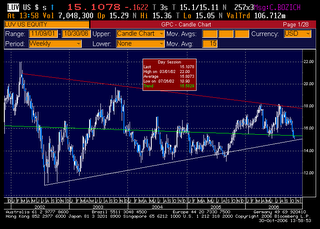
The stock is at a 52-week and multi-year low, while I think it could have near-term downside to the mid $14 area, it should have some support at current levels...particularly given that the company has been earnings money the past five years and trades at a lower valuation than it did then...
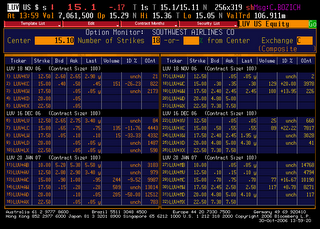
Here is a chart-printing of the option. If you prefer to own the stock, but want a yield higher than Southwest's meager .12% payout (perhaps the major chink in the LUV bull argument), you can always write the $15 call. Again, these strategies only make sense if you have ultra-low commissions(similar to Southwest's ticket prices)
Is free peanuts a valid investment thesis? (The answer to that rhetorical question is yes, in case you didn't know). Look what happened to Lone Star Steakhouse when they removed the peanuts from their restaurant. There were some other problems with sales and earnings, which were probably due to the lack of peanuts I imagine.
G. Gerswhin-" Life is a lot like jazz... It's best when you improvise"
Sold the $15 November Put (20 days to expiration) for $.30/share. Net of commission, this amounts to a target return of 2.0% on my $14.71 VAR (value-at-risk). This amounts to an annualized rate of return of 35% on VAR that is invested in one of the best airlines EVER. I could cite labor costs, lack of strikes, no bankruptcy, consecutive years of profitability, hedged fuel costs below $40/bbl of oil, its own reality television show, but instead I think the most telling feature is that Southwest manages to accomplish its historical profitability without compromising on customer service (i.e- they still give out peanuts and an ENTIRE can of soda), unlike those bastards at other airlines.

The stock is at a 52-week and multi-year low, while I think it could have near-term downside to the mid $14 area, it should have some support at current levels...particularly given that the company has been earnings money the past five years and trades at a lower valuation than it did then...
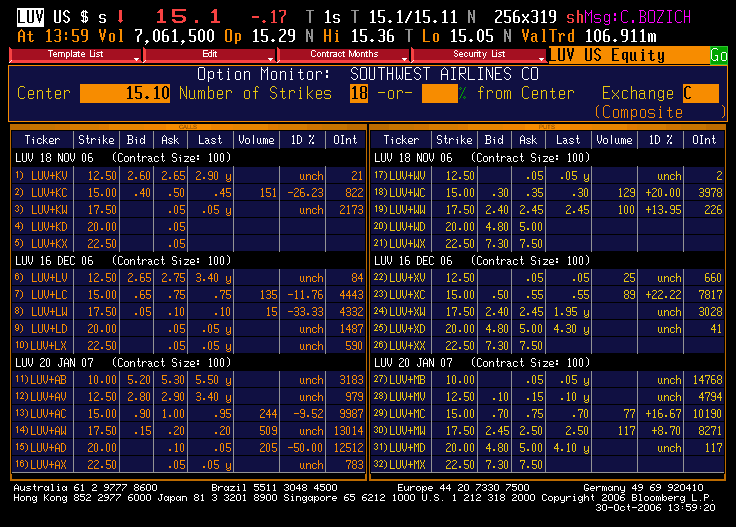
Here is a chart-printing of the option. If you prefer to own the stock, but want a yield higher than Southwest's meager .12% payout (perhaps the major chink in the LUV bull argument), you can always write the $15 call. Again, these strategies only make sense if you have ultra-low commissions(similar to Southwest's ticket prices)
Is free peanuts a valid investment thesis? (The answer to that rhetorical question is yes, in case you didn't know). Look what happened to Lone Star Steakhouse when they removed the peanuts from their restaurant. There were some other problems with sales and earnings, which were probably due to the lack of peanuts I imagine.
Sunday, October 29, 2006
I Wanna (Florida) ROCK!
Pat Riley- "Giving yourself permission to lose guarantees a loss. "
Florida Rock rallied 15% on Friday (at the high of the day), before finishing up around +8%. I continue to own this position, which performed this rally on NO news and no earnings announcements. The key driver of the stock gain appears to be a buyout offer that Cemex launched to acquire Rinker. The buyout offer values Rinker at nearly 10x Ebitda, while at the same there is a private equity push at TXI (Texas Industries) , which is also trading above 10x Ebitda. While Florida is not currently considered the "hottest" residential housing market around... it has historically rebounded and still holds a lot of what can't be rebuilt on the prairie (namely, waterfront property).
Florida Rock is only about 40% exposed to the residential market in Florida, due to its diversification in the Southwest and maintains a very strong balance sheet, with negative net debt. At 7x Ebitda (trailing), its hard to want to sell this stock on a 15% up-day in trading, especially when one considers the chronic cement shortages that have plagued builders in that state for the past three years (state is a net importer). Perhaps I'm being greedy, but historically selling (too soon) good companies as they start to overcome investor pessimism has been my weakness. I would expect to see this stock approach the $50-55 area within the next few months, if only to move in-line with where other cement/aggregate companies are valued at in the marketplace.
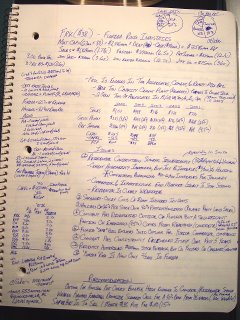
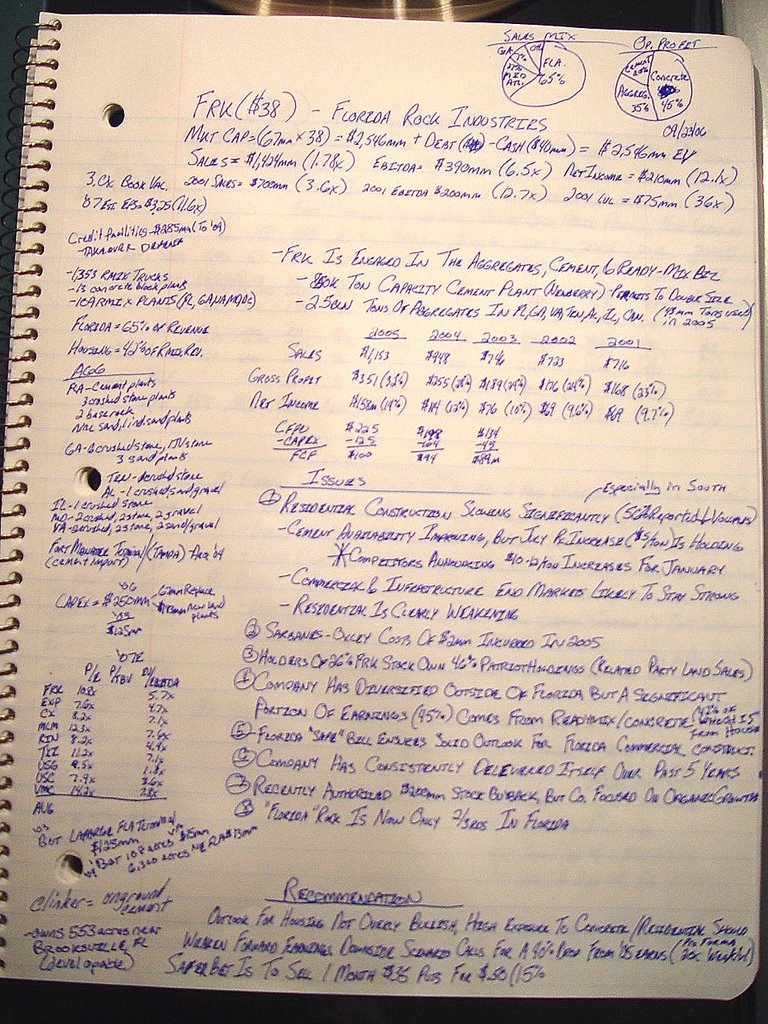
Long FRK (up to $43, from purchase price at $38)- Writeup from Sept. 06 Journal below
Pat Riley- "Giving yourself permission to lose guarantees a loss. "
Florida Rock rallied 15% on Friday (at the high of the day), before finishing up around +8%. I continue to own this position, which performed this rally on NO news and no earnings announcements. The key driver of the stock gain appears to be a buyout offer that Cemex launched to acquire Rinker. The buyout offer values Rinker at nearly 10x Ebitda, while at the same there is a private equity push at TXI (Texas Industries) , which is also trading above 10x Ebitda. While Florida is not currently considered the "hottest" residential housing market around... it has historically rebounded and still holds a lot of what can't be rebuilt on the prairie (namely, waterfront property).
Florida Rock is only about 40% exposed to the residential market in Florida, due to its diversification in the Southwest and maintains a very strong balance sheet, with negative net debt. At 7x Ebitda (trailing), its hard to want to sell this stock on a 15% up-day in trading, especially when one considers the chronic cement shortages that have plagued builders in that state for the past three years (state is a net importer). Perhaps I'm being greedy, but historically selling (too soon) good companies as they start to overcome investor pessimism has been my weakness. I would expect to see this stock approach the $50-55 area within the next few months, if only to move in-line with where other cement/aggregate companies are valued at in the marketplace.
Long FRK (up to $43, from purchase price at $38)- Writeup from Sept. 06 Journal below
Thursday, October 26, 2006
It A'int Pretty But Its Cheap!
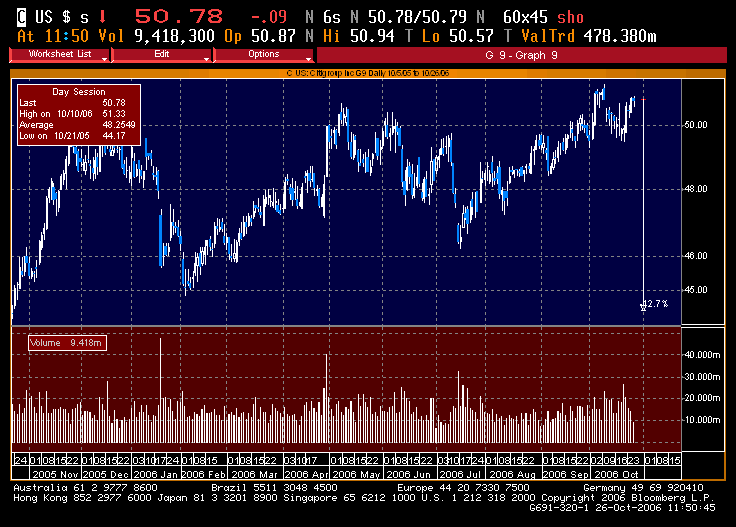
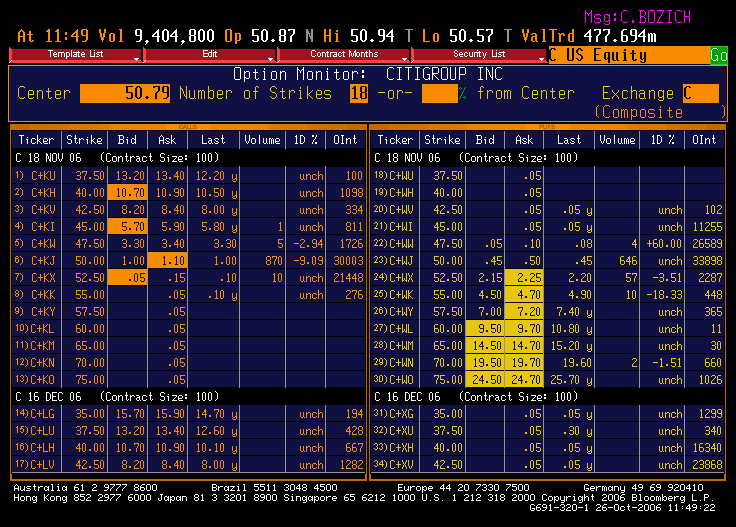
Have noticed that some of these bank stock options are not paying close attention to the dividends on the underlying stock, too focused on volatility numbers, etc.
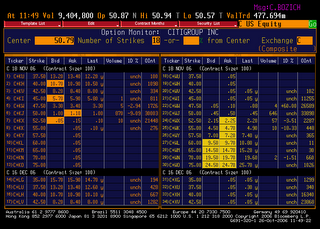
Here is the trade, sold $45 November calls on Citigroup @$5.80, while buying the stock at $50.80. If Citigroup closes above $45 (or does not fall 13%) by November 18th, then this trade will net me $50.80 per share, versus my cost basis of $50.80. Not a great-sounding trade you say? Lest I forget, Citigroup will pay a dividend to holders of the stock on November 6th.... of $.49/share.... which is really all you get out of the trade.
So doing the math, we are really only risking that the stock falls below $45, with that being our net investment in the trade. For a 23 day holding period then, we will earn ($.49-.02 commissions)/$45 at-risk =1.04%,annualized gain*(365/23 days)=16.5%
Have noticed that some of these bank stock options are not paying close attention to the dividends on the underlying stock, too focused on volatility numbers, etc.
Here is the trade, sold $45 November calls on Citigroup @$5.80, while buying the stock at $50.80. If Citigroup closes above $45 (or does not fall 13%) by November 18th, then this trade will net me $50.80 per share, versus my cost basis of $50.80. Not a great-sounding trade you say? Lest I forget, Citigroup will pay a dividend to holders of the stock on November 6th.... of $.49/share.... which is really all you get out of the trade.
So doing the math, we are really only risking that the stock falls below $45, with that being our net investment in the trade. For a 23 day holding period then, we will earn ($.49-.02 commissions)/$45 at-risk =1.04%,annualized gain*(365/23 days)=16.5%
Tuesday, October 24, 2006
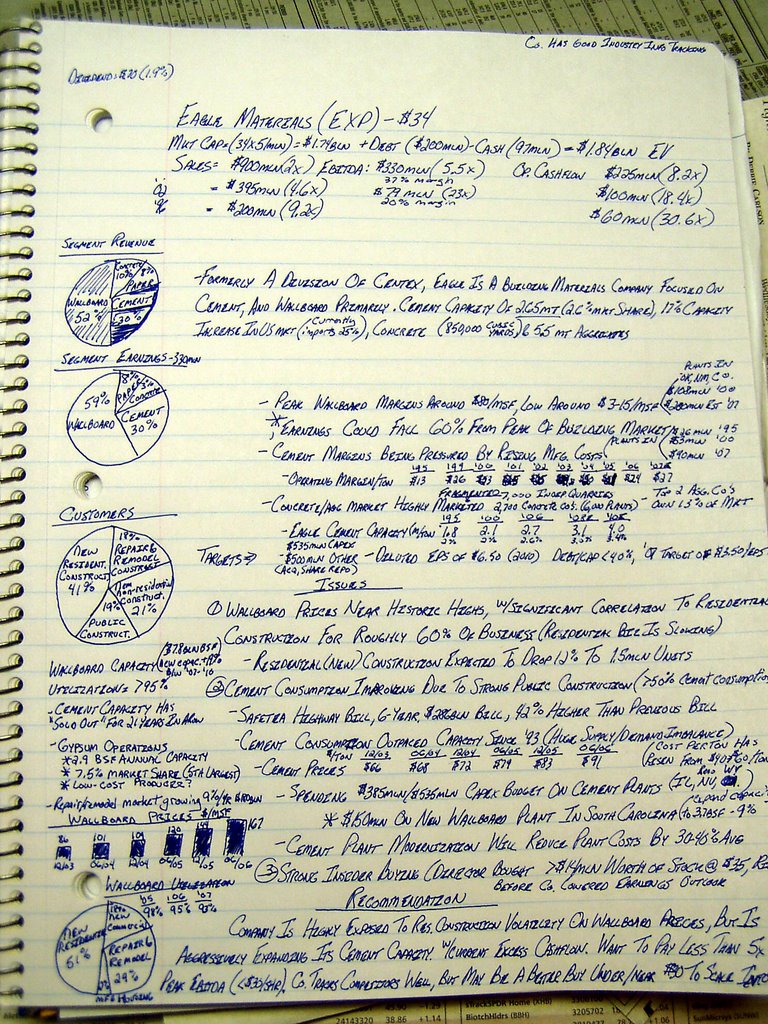
EXP- Eagle Materials: Attached to this post is a sample of one of my note-book writeups on Eagle Materials. They recently had several large insider buys in their stock, but hopefully this gives a sample of some of the info I focus on when analyzing a company/industry. I am extremely impressed with the grasp of EXP management on their market dynamics... however I would probably wait to buy the stock if it gets to the low 30's again. 
Saturday, October 21, 2006
Well... the market is at a 52 week high and up about 12% for the past twelve months (depending on which market qualifies as "the market" to you. For the past 2-3 months, a lot of stock I have been following are up 15-20%, with very few of the decent-quality companies trading near their lows.
The only recent market overreaction has been in the energy sector, with many drillers and oil service companies getting clobbered due to oil price declines. I bought HYDL at $50.50, which has rallied up about 7-8 points in about a week. I only bought 1/3rd of a position, as I was buying into it as a falling knife. I like management, company has >10% of market cap in cash, no debt, and dominant market position in premium connections (deep sea oil drilling). I should have bought more exposure in this sector, possibly including GRP (grant prideco) below $35. Recent buyouts of NSS and MVK (steel tubing for drill pipe) bode favorably for this sector, possibly affording buyout interest in either GRP or HYDL longer-term.
Recent strong performers for me have been GTRC, CPWR. AGYS, FRK, CCRT, DEBS, IUSA,JBHT, YUM, HYDL, DRI, EAT, and several others. Am debating buying some WSM in the low 30s due to strong insider buying and decent niche retail concept. JLG is a solid trucking company (aerial lifts) that was oversold and had just hit my low-debt/valuation screen....prior to receiving a buyout offer more than 25% above its prior closing price. Ironically, even after the huge jump in stock price it is still on my low-valuation screen! Deluxe Corp (check printer) is also up nearly 50% from its $14-15 bottom of a few months ago. I hated this company and their extremely weak former management, however new CEO Lee Schram appears to have the right stuff and has made some tough decisions to preserve cashflow. Based on their high debt leverage and strong current cashflow, DLX is LBO bait if the stock price fell below $20/share, although I am less excited about it at $22/share (upside to $30?) Am not excited about a lot of names and am waiting for some opportunities to develop. Will continue waiting for some exciting names to go on sale....
Monday, July 17, 2006
Friday, June 30, 2006
A Couple of Ideas I'm working on....
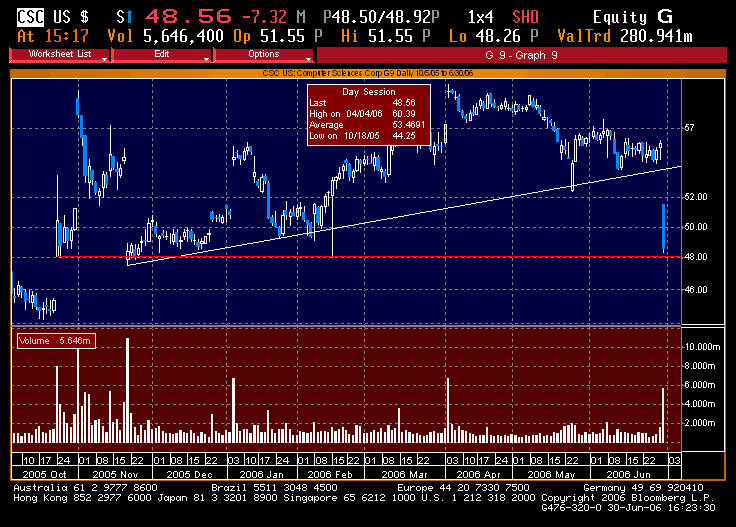
BUY CSC @$48 range. CSC announced their company was not going to be sold to a buyout group, but that they would be going ahead with a $2bln stock repurchase, which represents 22% of their floated shares. The company is also subject to an options-grant investigation that most companies are facing, but in any event their stock fell 13%...half of which occurred intraday. On a technical basis I think their is support at $48, and additional longer-term support in the $43-45 range. I would have liked to sell the puts, but their options pricing is way too skimpy and doesnt compensate for the risk associated with writing them.
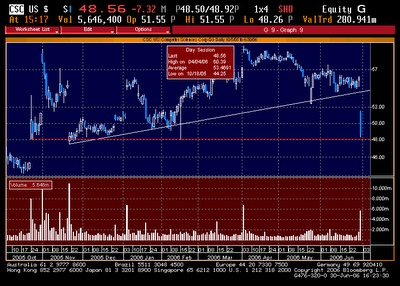 I am recommending putting on a trade position in 1/4 sizes at a time and hope to sell the puts at the right premium level.CSC trades at 4.3x ev/ebitda, vs. the market average valuation multiple closer to 7-8x. Any stock repurchases below $50 should enhance a buyout firm's ability to step back into the picture and pay a larger premium on the remaining shares, so I am fairly positive on the outlook.
MWY- Short Squeeze Part deux?
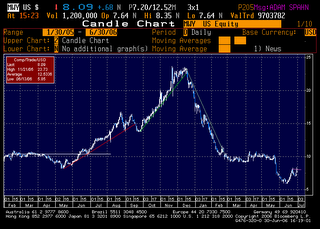
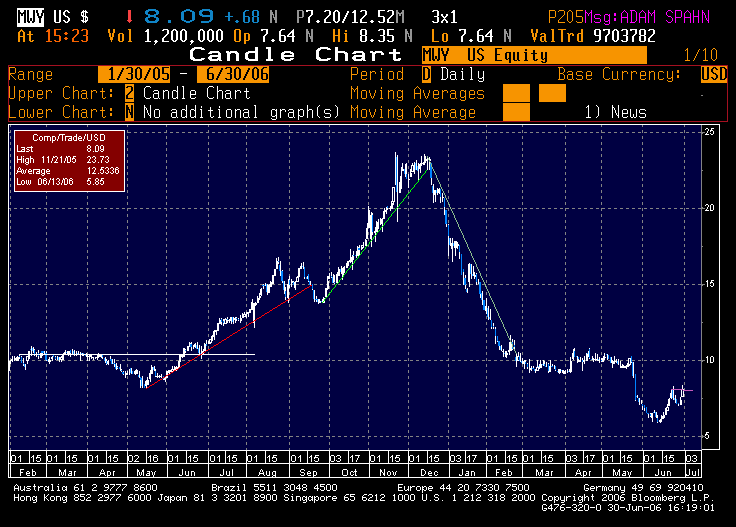
MWY is also forming a killer short squeeze, 95% of the floated shares are tied up and Sumner Redstone appears to be moving in tor the kill, buying 1% of the outstanding float per day. Sumner's buying in the single-digits and low-teens in 2005 caused the stock to move from $8 to $24 last year. After he ceased buying MWY stock in the high teens, it has since fallen to $7 (admittedly, the company is a terd). However, since he has restarted stock repurchases in the past two days the stock is up 15% to $8.09. With approximately 2MM shares short and 7.6MM in the float, there is the distinct possibility of a short squeeze into the low double digits... as Redstone owns 85% of the company and is very near the 90% threshold required to take the company private.
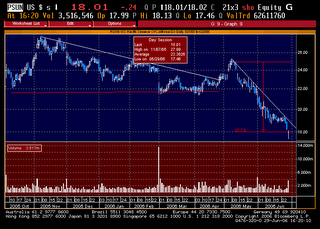
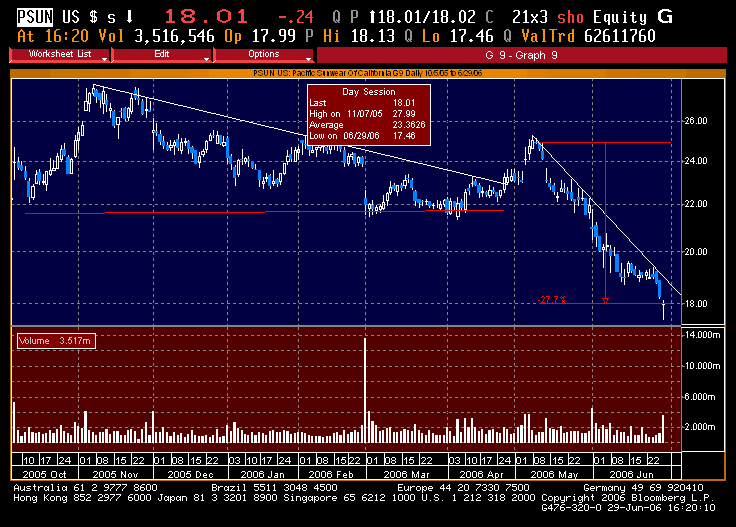
BUY PSUN under $18- continue averaging into position as stock trades down
Am also looking at value in CLE- Claire's Stores (less fashion-sensitive than other retailers), and DG (which is less economically sensitive than other dollar stores and is trading at approximately 12x peak free-cashflow. All of these names are oversold,
PSUN is down almost twenty percent from where I first noted it as being potentially interesting. While I was more concerned after checking out some of their stores, they are now trading at around 4.5x trailing ebitda ( versus 6.5x for the group, which is still below the market at 7.5-8.0x). Essentially, if PSUN's earnings were chopped in half, they would have a P/E of around 21x. While that P/E level is high, for a depressed earnings multiple and worst-case scenario it would seem to indicate that current levels offer a good entry point.
BUY CSC @$48 range. CSC announced their company was not going to be sold to a buyout group, but that they would be going ahead with a $2bln stock repurchase, which represents 22% of their floated shares. The company is also subject to an options-grant investigation that most companies are facing, but in any event their stock fell 13%...half of which occurred intraday. On a technical basis I think their is support at $48, and additional longer-term support in the $43-45 range. I would have liked to sell the puts, but their options pricing is way too skimpy and doesnt compensate for the risk associated with writing them.
 I am recommending putting on a trade position in 1/4 sizes at a time and hope to sell the puts at the right premium level.CSC trades at 4.3x ev/ebitda, vs. the market average valuation multiple closer to 7-8x. Any stock repurchases below $50 should enhance a buyout firm's ability to step back into the picture and pay a larger premium on the remaining shares, so I am fairly positive on the outlook.
MWY- Short Squeeze Part deux?
MWY is also forming a killer short squeeze, 95% of the floated shares are tied up and Sumner Redstone appears to be moving in tor the kill, buying 1% of the outstanding float per day. Sumner's buying in the single-digits and low-teens in 2005 caused the stock to move from $8 to $24 last year. After he ceased buying MWY stock in the high teens, it has since fallen to $7 (admittedly, the company is a terd). However, since he has restarted stock repurchases in the past two days the stock is up 15% to $8.09. With approximately 2MM shares short and 7.6MM in the float, there is the distinct possibility of a short squeeze into the low double digits... as Redstone owns 85% of the company and is very near the 90% threshold required to take the company private.
BUY PSUN under $18- continue averaging into position as stock trades down
Am also looking at value in CLE- Claire's Stores (less fashion-sensitive than other retailers), and DG (which is less economically sensitive than other dollar stores and is trading at approximately 12x peak free-cashflow. All of these names are oversold,
PSUN is down almost twenty percent from where I first noted it as being potentially interesting. While I was more concerned after checking out some of their stores, they are now trading at around 4.5x trailing ebitda ( versus 6.5x for the group, which is still below the market at 7.5-8.0x). Essentially, if PSUN's earnings were chopped in half, they would have a P/E of around 21x. While that P/E level is high, for a depressed earnings multiple and worst-case scenario it would seem to indicate that current levels offer a good entry point.
Subscribe to:
Posts (Atom)