USM analyis-
Recommendation to buy USM bonds- UZV, UZG, GJH
I previously recommended buying UZV preferred (see earlier post for cursory credit analysis). As a refresher, UZV is a preferred-stock whose underlying asset is 30-year senior unsecured notes of US Cellular (USM 7.5% notes). Based on current price of $15 (60% of par), the yield on this senior note is approximately 12.5%, whereas peer-company bond yields for Verizon, Telefonica, Vodafone, DT (Tmobile), and AT&T average nearly 6.5% (+350bps over 30yr treasury rate of 3%).
US Cellular is a good credit risk, with minimal leverage relative to the underlying value of the business. For example, Verizon recently purchased Alltel (in cash) for $28Bln, which equates to a valuation multiple of $2,500 for each of Alltel's 11Mln subscribers. Although Verizon dramatically overpaid for Alltel, let's assume that US Cellular is worth at least half of this multiple ($1,250/subscriber). Based upon 6.3Mln subscribers x $1,250/subscriber=$7.9Bln implied enterprise value. Since US Cellular has only $1bln in debt and a core business intrinsically worth at least $7.9Bln, its debt is well-protected and safe (by a factor of 7.9x). In addition, the company also owns a 5.5% interest in a major Verizon wireless asset (SMSA LP) that generates an additional $80Mln income per year. I assume this is worth an additional $800 Mln ($80Mln/10% discount rate).
In total, US Cellular's enterprise value is worth $8.7Bln ($7.9Bln for core business + $800Mln for partnerships owned). After subtracting out net debt of $820Mln ($1Bln gross debt- $180Mln cash), the remaining intrinsic value of the equity is $7.9Bln. This equates to $90/share in intrinsic value per share ($7.9Bln/87Mln shares outstanding). Currently, USM stock is at $45/share, which implies a 50% discount to the intrinsic value of the company.
Recommendation- USM bonds appear to have at least 50% upside and are generating significant current income, regardless of whether management maximizes the value of the company. As such, I recommend buying UZV. Full disclosure- I have owned UZV since $11.50 and have been a buyer as high as $14.50. I would only buy the stock if it fell into the $30s (200% upside), as the bonds (traded on NYSE under UZV, UZG, GJH are more attractive and safer at current levels)
Monday, January 05, 2009


Tuesday, December 23, 2008
Buy FJA preferred (Embarq 2036 bonds)
FJA is a preferred listed on the nyse. The underlying asset interest that is owned in the preferred trust is embarq long- dated senior debt securities. The preferred pays dividends of 1.78, which equates to 17pct current yield and a discount to par of 55 percent (paying 45 cents on the dollar). Embarq is a decent, but not great credit... Wireline subscribers are shrinking 5-7pcercent, and debt leverage is high, but manageable for the business risk profile (2.2x levered). The company is switching subscribers of phone service over to dsl, which should limit the defections of subscriber base to digital cable. Another plus is that centurytel is acquiring embarq, which should result in better efficiency, larger size, and improved credit profile ( centurytel is more rural, thus more protected from cable penetration). Aside from these factors, long embarq debt trades around 65$, which is 20$ (42pct) higher than the implied purchase price via the FJA preferred. Thus the below-market price, high yield, and potential upside in credit profile make this security extremely attractive at prices below $12.50. Recommendation- buy FJA
This email, including any attachments, is intended for the person(s) or company to whom it is addressed and may contain confidential and/or legally privileged information. If you are not the intended recipient, please be advised that you have received this message in error and that unauthorized disclosure, forwarding, printing or copying of this information is strictly prohibited and may be unlawful. Please notify the sender immediately, either at the original sender's email address, or by calling 1-888-391-2725. For all other questions please contact the company operator at (816) 391-2700.
Thursday, December 11, 2008
BUY UZG/UZV Preferred
The UZV/UZG are preferred stocks traded on the NYSE. The preferreds represent ownership interest in a trust, which owns 7.5% and 8.75% US Cellular Senior Notes, due in the 2030s.
The "par" amount of the preferred shares is $25, although the UZV currently trades at $13.25 (14.16% yield) and the UZG currently trades at $18.9 (11.7% yield). There is another US Cellular baby-bond listed under GJH, which trades at $4.80 ($10 "par" value), for a yield of 13.2%. I am ignoring the GJH issue for now.
US Cellular is 70% owned by TDS and represents the primary asset of TDS.. US Cellular currently has $1Bln in debt vs. $177MMln cash. Trailing EBITDA over the past twelve months is $1.06Bln, on revenues of $4.2Bln (25% ebitda margin). US Cellular also owns some partnership interests in Verizon's Los-Angeles cell network In 2007, US Cellular generated operating cashflow of $863Mln, less capital expenditures of $565Mln, for free-cashflow of $298Mln. The company has adequate liquidity between its cash holdings and $700Mln revolver (expires 12/2009) and is currently profitable. USM is the last independent carrier, following the acquisition of Alltel by Verizon. Currently, Verizon bonds trade at +500/30yr (8.1% yield). Verizon Wireless bonds trade 50bp tighter than the holdco bonds.
As such, buying the US Cellular bonds appears to be attractively valued, in the form of this structured note. At current yields, I would recommend buying UZV, as the 14% yield and $13.25 price is very attractive (53% of par, a high discount for a non-distressed credit.. In fact, the dislocation in bond pricing actually presents an arbitrage opportunity, in which you can sell the high-priced UZG (76% of par, $18.90 price, 11.6% yield) and buy the lower-priced UZV notes for a positive arbitrage of 240 basis points and a significantly lower-dollar price relative to par. Its a win-win, or you could keep it simple and just buy UZV. I've tried a little of both, K-dawg
The "par" amount of the preferred shares is $25, although the UZV currently trades at $13.25 (14.16% yield) and the UZG currently trades at $18.9 (11.7% yield). There is another US Cellular baby-bond listed under GJH, which trades at $4.80 ($10 "par" value), for a yield of 13.2%. I am ignoring the GJH issue for now.
US Cellular is 70% owned by TDS and represents the primary asset of TDS.. US Cellular currently has $1Bln in debt vs. $177MMln cash. Trailing EBITDA over the past twelve months is $1.06Bln, on revenues of $4.2Bln (25% ebitda margin). US Cellular also owns some partnership interests in Verizon's Los-Angeles cell network In 2007, US Cellular generated operating cashflow of $863Mln, less capital expenditures of $565Mln, for free-cashflow of $298Mln. The company has adequate liquidity between its cash holdings and $700Mln revolver (expires 12/2009) and is currently profitable. USM is the last independent carrier, following the acquisition of Alltel by Verizon. Currently, Verizon bonds trade at +500/30yr (8.1% yield). Verizon Wireless bonds trade 50bp tighter than the holdco bonds.
As such, buying the US Cellular bonds appears to be attractively valued, in the form of this structured note. At current yields, I would recommend buying UZV, as the 14% yield and $13.25 price is very attractive (53% of par, a high discount for a non-distressed credit.. In fact, the dislocation in bond pricing actually presents an arbitrage opportunity, in which you can sell the high-priced UZG (76% of par, $18.90 price, 11.6% yield) and buy the lower-priced UZV notes for a positive arbitrage of 240 basis points and a significantly lower-dollar price relative to par. Its a win-win, or you could keep it simple and just buy UZV. I've tried a little of both, K-dawg
Thursday, December 04, 2008
Okay, if you bought CCS at my recommendation at $15, I am currently selling that at $17.10 ( 9.76% yield) and putting all proceeds into CCW at $17.35 (10.1% yield).
Even with a bit of commission, it is a nice pickup in yield. More importantly, CCW is larger/more liquid and generally trades at a lower yield than CCS (by like 20bps). That means CCS will normally trade $1.50 below CCW.... so this should be an easy trade.
Or, you can just sell CCS and pocket your 13% over the past week! I like the swap better though, as 10% is a nice yield.
Even with a bit of commission, it is a nice pickup in yield. More importantly, CCW is larger/more liquid and generally trades at a lower yield than CCS (by like 20bps). That means CCS will normally trade $1.50 below CCW.... so this should be an easy trade.
Or, you can just sell CCS and pocket your 13% over the past week! I like the swap better though, as 10% is a nice yield.
Tuesday, February 12, 2008
ClearChannel for Cowards...
ClearChannel for Cowards...
Right off the bat, I don't like ClearChannel, they seem to ruin every radio station. That being said, they can do whatever they want since Sirius/XM is the only real radio competition and I'm too cheap to pay (for now, anyway). CCU is currently involved in an LBO that appears to be on the rocks. The stock is trading below $30, in spite of the LBO bid at $39.25 (>33% higher). The LBO bid is ridiculous and values a radio company at 13x EBITDA, which is about where recent station-sales have been executed at.
I think a more reasonable multiple for a monopoly provider is closer to 8-9x Ebitda, which is way below any historical trading level for this company. The last time it traded at $20/share was in the recession of 2002 (its debt was $2.2Bln more than current levels) and before that, you have to go back to 1996 when it was much smaller. This company should generate around $2Bln Ebitda, which puts valuation around $16-18Bln EV. Minus $7Bln debt=$9-11Bln market cap/500 mln shares= $18-22/share.
I am not willing to buy the stock at $29 on the hopes an overpriced acquisition goes through. However, I am willing to sell one-month puts at $20 for $.40 (2% absolute yield b/f commissions) on the notion that the stock will be a decent buy if hell-freezes-over and the share price drops 30+% within the next month. I do not view this as highly likely, although I do expect weakness when the company reports earnings on February 14th. If you are a little bit braver, you can sell $22.50 puts for $.90 (4% absolute yield). I have only done this on a couple contracts per account, but its an interesting idea and arb play.
Friday, February 01, 2008
Snipes

"ALWAYS BET ON BLACK!"
- Snipes found not guilty of defrauding the government, after not paying taxes for 7-8 years, filing fraudulent tax returns, and fraudulently applying for tax refunds. He was also bouncing checks that he did send into the IRS.
I have a new favorite action hero. It is you, Mr Snipes. (Even if you do have a bad-taste in neckties)
http://www.reuters.com/article/entertainmentNews/idUSN2959375320080201?feedType=RSS&feedName=entertainmentNews&rpc=22&sp=true
Wednesday, January 30, 2008
Joke of the day
Joke of the Day- " Hey Ben Bernanke, Home Depot called, they want their tools back".
I'd better start making a lot more money in my stock portfolio, because inflations gonna be rippinig America a new asshole...as if it hasn't started already.
In other things, Robert Olstein listed his twenty financial-analysis criteria....thought it was worth posting
OLSTEIN’S TOP TWENTY QUALITY
OF EARNINGS ALERTS
1 Material deviations between net income and free cash flow
2 Material differences between the tax books and shareholder books as
measured by deferred taxes
3 Material changes in balance sheet debt and liquidity ratios
4 Inventories, especially finished goods or raw materials, increasing or
decreasing faster than sales
5 Accounts receivable increasing or decreasing faster than revenue
6 Deviations between depreciation and capital expenditures
7 The repetitiveness and materiality of non-recurring write-offs
8 The role that non-trend line changes in reserves contribute to, or negatively
impact, current earnings
9 The repetitiveness and materiality of non-recurring gains such as sales
from venture capital portfolios
10 The impact and reality of a company’s deferred expense capitalization
policies as it effects reported free cash flow
11 Discretionary expenses deviating materially above and below trend lines
12 The reality, consistency and conservativeness of revenue recognition
techniques when measured against the passing of cash
13 The impact that acquisitions have on sustainable free cash flow and the
growth thereof
14 Changes in other asset accounts
15 The impact of transactions with special-purpose vehicles
16 Pension income and expense recognition measured against the pension
plan’s assumptions and the funded status of the plan
17 Large deviations between pro forma and reported earnings
18 The impact of option transactions on reported free cash flow and the
impact on future results and valuations of the company
19 The capabilities of management as measured by their long-term decision-
making capabilities; especially when problems develop; their attitude
toward risk as measured by the quality of the balance sheet; and
their preparation for a rainy day; their methodology of communicating
with shareholders; and finally their ability and emphasis on returning
value to shareholders
20 Disclosure of material information needed to assess the value of the
company
T
Troy Peterson, CFA
Credit Analyst- Americo Life
Phone- 816-391-2039
Fax- 816-391-2037
Email- Troy.Peterson@americo.com
300 W. 11th St.
Kansas City, MO. 64105
SELL FDX and WM- I'm starting my shot clock
SELL FDX and WM- I'm starting my shot clock
Markets maybe got a week or two to rally more, but think the lows will be retested
Troy Peterson, CFA
Credit Analyst- Americo Life
Phone- 816-391-2039
Fax- 816-391-2037
Email- Troy.Peterson@americo.com
300 W. 11th St.
Kansas City, MO. 64105
Tuesday, January 29, 2008
CTL- Centurytel at $35, this is a phone-line company in mostly rural areas, about a $3.8Bln market cap and $3Bln in debt. 11.5x P/E, with approximately $600Mln in trailing free cashflow (actual). Calculated a different way (with more onerous tax assumptions), Centurytel's profitability is mapped out below.
Ebitda- 1325
-interest -220
-taxes(.35)- -350
Capex -300
FCF- $455 (ebitda method fcf)

That equates to about a 12% FCF yield ($455/$3.8Bln), but its actually closer to a 16% yield since I overstated their actual cash taxes. They have a share repurchase authorization for $750Mln, which is like 18% of their shares outstanding. 10% of their stock is held up in 401K/esop plans which means even fewer sellers will be out in the marketplace. This should easily trade up until the implied freecashflow yield is something closer to 8%, which would equate to about $48.80/share , based on a low-end free cashflow forecast of $430Mln/8%= $5,375Mln $5,375Mln/110Mln shares= $48.86 per share This implies 40% upside in the stock.
The company has a lot of debt, which will likely increase given the buyback, but they continue to do a good job switching old phone-line customers over to DSL packages and they should trade at a premium to Citizens Communications (CZN). Currently, CZN trades at EV/sales of 3.7x and ev/ebitda of 6.7x, while CTL trades at 2.6x sales and EV/Ebitda of 5.14x. Both of these multiples imply a 30-40% valuation gap between these similar companies. The free-cashflow numbers make Citizen's still look cheap ($740Mln/$3600= 20% FCF yield), but I believe this represents lower capital investment spending in their infrastructure, which may ultimately come back to bite them. I think the valuation gap mostly exists due to CZN paying a cash dividend of 9%, while CTL pays a yield of .8% (CTL pays its cash through share repurchases, which should prove more efficent as long as they avoid dilutive acquisitions).
Thought this was an interesting equity idea, but would be hesitant to buy the bonds due to the fact that they pay out all of their cash.
Ebitda- 1325
-interest -220
-taxes(.35)- -350
Capex -300
FCF- $455 (ebitda method fcf)

That equates to about a 12% FCF yield ($455/$3.8Bln), but its actually closer to a 16% yield since I overstated their actual cash taxes. They have a share repurchase authorization for $750Mln, which is like 18% of their shares outstanding. 10% of their stock is held up in 401K/esop plans which means even fewer sellers will be out in the marketplace. This should easily trade up until the implied freecashflow yield is something closer to 8%, which would equate to about $48.80/share , based on a low-end free cashflow forecast of $430Mln/8%= $5,375Mln $5,375Mln/110Mln shares= $48.86 per share This implies 40% upside in the stock.
The company has a lot of debt, which will likely increase given the buyback, but they continue to do a good job switching old phone-line customers over to DSL packages and they should trade at a premium to Citizens Communications (CZN). Currently, CZN trades at EV/sales of 3.7x and ev/ebitda of 6.7x, while CTL trades at 2.6x sales and EV/Ebitda of 5.14x. Both of these multiples imply a 30-40% valuation gap between these similar companies. The free-cashflow numbers make Citizen's still look cheap ($740Mln/$3600= 20% FCF yield), but I believe this represents lower capital investment spending in their infrastructure, which may ultimately come back to bite them. I think the valuation gap mostly exists due to CZN paying a cash dividend of 9%, while CTL pays a yield of .8% (CTL pays its cash through share repurchases, which should prove more efficent as long as they avoid dilutive acquisitions).
Thought this was an interesting equity idea, but would be hesitant to buy the bonds due to the fact that they pay out all of their cash.
Monday, January 14, 2008
Next Idea- Long/Short on MW/JOSB

margins of around 16%, but MW has been growing faster than JOSB. MW recently
warned on sales growth and their stock tanked. MW trades at .45x EV/sales, JOSB
trades at .76x sales. I think this is likely to converge, with most likely
outcome being that JOSB falls to MW (rather than MW rising significantly).
I'll map out the idea more fully this afternoon, but it looks pretty
interesting, given how obvious and straightforward the valuation disconnect
appears to be. The JOSB store I drive by every other day always seems to be
empty...
Thursday, January 10, 2008
New spec  plays possibly worth a multi-day
  trade.....
Mostly reflective of the market and possibly a number of other stocks, I noticed that these two stocks had interesting island formations. My personal experience is that stocks that are A) Sold off more than 30% from their 52 week highs B) Trading at/near their 52 week lows C) Shown an Island formation at the lows (that resulted in a stock falling at least 3% intraday, but recovering and ending near the opening price of the day) and D) followed up that island formation with a strong bullish-engulfing candle (long white candle) - tend to have the potential for significant outsize gains over the next few weeks. Sometimes the reactions are very explosive, and my target would be for a significant rebound.
In Wamu's case, a minimum of 25% should maybe be targeted, FDX maybe 10%? In either case, the chart pattern shows strong buying and a major reversal on good volume and on oversold conditions. If the chart pattern closes below the bottom of the island formation, its definitely busted and you should just take a loss on the trade. I would tend to say if the stocks close below the top of the island formation that the upside is likely to disappoint, so I may set my stop-loss there.
Since you are reading this blog online, the best way to explain it is that Island-reversal formations are the Jenna Jameson of chart patterns. And by that I mean the Jenna from 10 years ago, not the old-and-busted anorexic Jenna from now. Hope that gives ya some good perspective.
PS- Sadly, my fondness for historical valuation multiples and Chili's salsa has me licking my chops over the 15% decline in EAT (within the week after i bought, of course :), nonetheless this was a long-term trade 6-18 months thats targeting $30/share. The biggest hindrance may be the fact that management blew a bunch of money on share repurchases at high prices in 2007, but restaurants are definitely looking very interesting to me... think the Darden's and Brinker's of the world have the financial wherewithal to outlast a lot of the smaller, lower-margin also-rans. (by comparison, recent LBO's of Outback Steakhouse and Applebee's both occured at >10x Ebitda, with Chili's trading for 5x trailing Ebitda, there appears to be a significant margin-of-safety even if earnings were to temporarily decline for these guys. I may look to add to this position if it declines further, although seeing some insider buying might make me a bit more bullish.
 plays possibly worth a multi-day
  trade.....
Mostly reflective of the market and possibly a number of other stocks, I noticed that these two stocks had interesting island formations. My personal experience is that stocks that are A) Sold off more than 30% from their 52 week highs B) Trading at/near their 52 week lows C) Shown an Island formation at the lows (that resulted in a stock falling at least 3% intraday, but recovering and ending near the opening price of the day) and D) followed up that island formation with a strong bullish-engulfing candle (long white candle) - tend to have the potential for significant outsize gains over the next few weeks. Sometimes the reactions are very explosive, and my target would be for a significant rebound.
In Wamu's case, a minimum of 25% should maybe be targeted, FDX maybe 10%? In either case, the chart pattern shows strong buying and a major reversal on good volume and on oversold conditions. If the chart pattern closes below the bottom of the island formation, its definitely busted and you should just take a loss on the trade. I would tend to say if the stocks close below the top of the island formation that the upside is likely to disappoint, so I may set my stop-loss there.
Since you are reading this blog online, the best way to explain it is that Island-reversal formations are the Jenna Jameson of chart patterns. And by that I mean the Jenna from 10 years ago, not the old-and-busted anorexic Jenna from now. Hope that gives ya some good perspective.
PS- Sadly, my fondness for historical valuation multiples and Chili's salsa has me licking my chops over the 15% decline in EAT (within the week after i bought, of course :), nonetheless this was a long-term trade 6-18 months thats targeting $30/share. The biggest hindrance may be the fact that management blew a bunch of money on share repurchases at high prices in 2007, but restaurants are definitely looking very interesting to me... think the Darden's and Brinker's of the world have the financial wherewithal to outlast a lot of the smaller, lower-margin also-rans. (by comparison, recent LBO's of Outback Steakhouse and Applebee's both occured at >10x Ebitda, with Chili's trading for 5x trailing Ebitda, there appears to be a significant margin-of-safety even if earnings were to temporarily decline for these guys. I may look to add to this position if it declines further, although seeing some insider buying might make me a bit more bullish.
Thursday, December 27, 2007


Brinker International(ticker symbol EAT) trades at .7x sales and 8.5x trailing operating profit. There seems to be a glut of restaurants in most fast-growing suburban marketplaces, which could be a problem if consumer discretionary income falls off and cost-inflation continues to ramp up. All that being said, Brinker's share price has fallen from $35 to $20...they may not have as much hidden real estate value as Darden owns, but it does own more than 1/4th of its stores and owns some strong concepts in Maggiano's, Chili's, and On-theBorder. Now that I mention it, Darden might be a good buy eventually too....
As the chart above shows (w/green line, Brinker is trading at a historically low Price/Sales multiple, my target would be to see it increase from .55x sales to 1x sales, which would be an increase of 90% from current levels.
Friday, November 02, 2007

Oh Yeah! Bernanke!
As the Federal Reserve continues to throw water onto a grease fire, it seems there are a lot more unknown problems waiting to surface. My theory (stolen from other smart people) is that the subprime scare and current "credit crisis" is a function of too much easy-money and liquidity in the system. Instead, the Fed is acting as if no-money down loans on $500,000 Miami condos to NINJAs (No Income/No Job or Assets) is a worthwhile cause to fight for. The Federal Reserve continues to cut interest rates, which is decimating an already-weak dollar...which is going to really spike inflation (which has already been rising well above 5% per annum- excluding home-price depreciation)
I'm probably silly to be so picky about stocks right now, since this initial inflation surge will likely cause a lot of companies with tangible assets and low Price/Books to be revalued higher...along with rapid price inflation that allows companies to report large earnings increases (that maybe reflect inflation more than true pricing power). The markets focus on a few stocks like GOOG $700+, BIDU $390+, AAPL $180+, AMZN$85+, and RIMM seems silly and highly reminiscent of the nifty-50 from the 1970s. This will probably end with these stocks doubling from their current levels, before falling back to around 50% of their current levels. (Yes, Google, I'm talking about you!)
Current stocks I'm interested in:
AEA-$9, scummy payday lender, trading 5x trailing FCF. Once gas prices hit $4/gallon, people are going to need to borrow against next months paycheck if they want to afford enough gas to get to work.
MHP-$46- Owns S&P and some publishing businesses, 12x trailing FCF, but likely to get hit by scrutiny surrounding their ratings of subprime business etc. I guess i just like pain, at least when this thing goes down 15% on me, I can say that I didnt buy it at the 52-week high at $72.50. S&P makes 40% operating margins on its ratings biz and people will be borrowing money again soon someday, their business is something akin to a toll-collector...a good biz to be in.
LUV-$12.5- Another bad idea, buying Southwest Airlines. Not only won't they do something dumb like LBO, their fuel hedges don't give them a competitive advantage at current high levels. These guys have rapidly increased fares and are no longer a "discount" airline. All the same, low leverage and good service make it worth selling $12.50 puts...it didnt even stay below $12.50 after 9/11... so I doubt mortgage messes or high oil prices will either.
LOJN- $15- Lojack has 25% of their market cap in cash and no debt, 12x trailing FCF but low growth. Stock down from $24/share on worries about new auto sales. Im not super bullish, but selling $15 puts is earning me 3% in exchange for my willingness to buy this stock on a dip...not a bad tradeoff.
MRH-$17- strong insider buying, somewhat risky reinsurer that screwed up badly ahead of Hurricane Katrina, but appears to have recovered and learned its lesson. Earning strong returns, although the P&C market is weakening. Believe the insider buying is a show of confidence in strategy. Also like HCC, which underwrites niche insurance like aviation, bail bonds, etc. and is growing faster.
I'm also watching all the insider buying going on at mortgage insurers, but RDN/MTG/PMI have all continued falling even after the bullish signals. I cant get my hands around where the bottom is, but am torn between waiting to buy the stock or buying a crapload of calls. Banks continue to buy insurance from these guys, so this is one of the areas where returns could potentially be huge. (although 2007-2009 losses might be "huge-er"... is that a word?). If anyone wants to talk mortgage insurance, I've got some thoughts....feel free to share your own.
Friday, August 24, 2007
ISYS is doing a tender offer on its stock at $27 a share. They are a small, $270MM mkt cap tech company with too much cash and a slightly rich stock valuation that has gone nowhere the past five years. Their price is $24.50, I am recommending that you buy 99 shares of the stock at any price under $24.50. The tender offer runs through September 11th, so you just have to notify your broker to submit your shares at $27, with "odd-lot-preference" treatment.
I bought Oceans Seven their 99 shares, and am buying 99 shares for my and Jennys personal accounts. The trick is that no more than 99 shares are registered to each person, that ensures you will get all your shares bought once the tender offer is completed. At $24.50, your gain is $248, less commissions, for about a months investment of $2450..... oh, and if you buy today you will pick up a $6 dividend (woo hoo!) as well.
I bought Oceans Seven their 99 shares, and am buying 99 shares for my and Jennys personal accounts. The trick is that no more than 99 shares are registered to each person, that ensures you will get all your shares bought once the tender offer is completed. At $24.50, your gain is $248, less commissions, for about a months investment of $2450..... oh, and if you buy today you will pick up a $6 dividend (woo hoo!) as well.
Friday, August 10, 2007
SUBPRIME AND CRAMER FOR THE RECORD-
Cramer two weeks ago in mid July....
Cramer now....
I think he gives a pretty accurate picture of the two-faced nature of a lot of these Wall Street guys....they leverage up irresponsibly, then when they wreck the system they want Mommy (or Bernanke) to bail them out. The Colbert followup is hilarious. As it stands, I am currently short an ACS $50 put (that is now in the money) and am at a loss....hope to get "put" the stock, as the potential buyout price on the company is above $60/share (30% premium to current price). Also am long some Broadridge stock and Discover Financial, both hedged with covered calls. Idiots are hoping the Fed will add liquidity to the market so they can get big market rallies....not "save the economy".... sometimes its just annoying to watch the market.
Cramer two weeks ago in mid July....
Cramer now....
I think he gives a pretty accurate picture of the two-faced nature of a lot of these Wall Street guys....they leverage up irresponsibly, then when they wreck the system they want Mommy (or Bernanke) to bail them out. The Colbert followup is hilarious. As it stands, I am currently short an ACS $50 put (that is now in the money) and am at a loss....hope to get "put" the stock, as the potential buyout price on the company is above $60/share (30% premium to current price). Also am long some Broadridge stock and Discover Financial, both hedged with covered calls. Idiots are hoping the Fed will add liquidity to the market so they can get big market rallies....not "save the economy".... sometimes its just annoying to watch the market.
Friday, June 15, 2007
The buyout/LBO-boom has just witnessed its first major casualty....
Ronco, Maker of the Veg-O-Matic, Files for Bankruptcy (Update2)
2007-06-15 13:05 (New York)
(Adds sale of company in third paragraph.)
By Jeff St.Onge
June 15 (Bloomberg) -- Ronco Corp., maker of the Veg-O-Matic
vegetable slicer and Pocket Fisherman, filed for bankruptcy two
years after founder and television pitchman Ron Popeil sold the
company.
Ronco, which marketed products as perfect for ``grads and
dads,'' sought protection from creditors owed more than $32.7
million. It listed $13.9 million in assets in papers filed
yesterday in U.S. bankruptcy court in Woodland Hills, California.
A sale of Ronco ``in the coming weeks is the best and most
viable mechanism for preserving'' the company's value, Chief
Executive Officer John S. Reiland said in the bankruptcy filing.
Reiland said Ronco will be sold through a court-supervised
auction and already has a potential buyer.
Popeil, 72, started the Chatsworth, California-based company
in 1958 and became a household name by hawking products in late-
night television ads. He was known for infomercials selling his
products, and got his start pitching his father's Veg-O-Matic
manual food processor with the phrase: ``It slices! It dices!''
Ronco was sold by Popeil to a holding company, Fi-Tek VII,
in June 2005, according to court papers. The buyer kept the Ronco
name and the right to purchase products Popeil invents before
they are offered elsewhere. He continues to work for Ronco as a
consultant and spokesman.
`But wait, there's more'
Popeil Inventions, owed more than $11.7 million, and other
companies owned by Popeil are listed in court papers as Ronco's
largest creditors. His inventions include a machine that
scrambles eggs inside the shell, a food dehydrator, an automatic
pasta-maker and a spray to cover bald spots on people's heads.
Among the company's best-selling gadgets is the Pocket
Fisherman, a compact rod and reel.
Popeil is listed as an inventor on more than two dozen U.S.
patents, according to the U.S. Patent and Trademark Office. His
fast-paced TV ads added phrases to the lexicon, such as ``But
wait, there's more'' and ``four easy payments.''
Popeil placed Ronco under bankruptcy court protection in
February 1984, and the company stopped doing business until he
resurrected the business with a former company salesman.
Fi-Tek VII's buyout in 2005 left Ronco with about $250,000
cash, Reiland said in court papers. The cash ``problem was
compounded by the fact that Ronco was entering the period where
it required significant working capital in order to acquire
inventory for the busy holiday season,'' he said.
`Wow, That's Terrific Bass!'
Stacia Neeley, Ronco's bankruptcy lawyer, didn't return a
call seeking comment. Popeil didn't return a message left with
his assistant.
In August, Ronco fired President and Chief Executive Officer
Richard Allen. He was replaced by Reiland, who first joined the
company in June 2005, according to court papers.
Ronco shares, which peaked at $2.60 in June 2006, almost
doubled, jumping 6 cents to 13 cents at 9:30 a.m. in over-the-
counter Bulletin Board trading.
Ronco's television ads were so familiar to viewers that they
were spoofed by comedian Dan Aykroyd in a famous 1976 sketch on
the television program ``Saturday Night Live.'' In the sketch,
Aykroyd advertises the ``Super Bass-O-Matic '76'' by ``Rovco,'' a
blender that turns a whole fish into a brown liquid, which is
then drunk by Laraine Newman, who co-starred in the segment.
``Wow, that's terrific bass!'' she says.
The case is In re Ronco Corp., 07-12000, U.S. Bankruptcy
Court for the Central District of California (San Fernando
Valley).
--With reporting by Anthony Aarons in London, Susan Decker in
Washington and Bob Van Voris in New York. Editor: Rovella
Ronco, Maker of the Veg-O-Matic, Files for Bankruptcy (Update2)
2007-06-15 13:05 (New York)
(Adds sale of company in third paragraph.)
By Jeff St.Onge
June 15 (Bloomberg) -- Ronco Corp., maker of the Veg-O-Matic
vegetable slicer and Pocket Fisherman, filed for bankruptcy two
years after founder and television pitchman Ron Popeil sold the
company.
Ronco, which marketed products as perfect for ``grads and
dads,'' sought protection from creditors owed more than $32.7
million. It listed $13.9 million in assets in papers filed
yesterday in U.S. bankruptcy court in Woodland Hills, California.
A sale of Ronco ``in the coming weeks is the best and most
viable mechanism for preserving'' the company's value, Chief
Executive Officer John S. Reiland said in the bankruptcy filing.
Reiland said Ronco will be sold through a court-supervised
auction and already has a potential buyer.
Popeil, 72, started the Chatsworth, California-based company
in 1958 and became a household name by hawking products in late-
night television ads. He was known for infomercials selling his
products, and got his start pitching his father's Veg-O-Matic
manual food processor with the phrase: ``It slices! It dices!''
Ronco was sold by Popeil to a holding company, Fi-Tek VII,
in June 2005, according to court papers. The buyer kept the Ronco
name and the right to purchase products Popeil invents before
they are offered elsewhere. He continues to work for Ronco as a
consultant and spokesman.
`But wait, there's more'
Popeil Inventions, owed more than $11.7 million, and other
companies owned by Popeil are listed in court papers as Ronco's
largest creditors. His inventions include a machine that
scrambles eggs inside the shell, a food dehydrator, an automatic
pasta-maker and a spray to cover bald spots on people's heads.
Among the company's best-selling gadgets is the Pocket
Fisherman, a compact rod and reel.
Popeil is listed as an inventor on more than two dozen U.S.
patents, according to the U.S. Patent and Trademark Office. His
fast-paced TV ads added phrases to the lexicon, such as ``But
wait, there's more'' and ``four easy payments.''
Popeil placed Ronco under bankruptcy court protection in
February 1984, and the company stopped doing business until he
resurrected the business with a former company salesman.
Fi-Tek VII's buyout in 2005 left Ronco with about $250,000
cash, Reiland said in court papers. The cash ``problem was
compounded by the fact that Ronco was entering the period where
it required significant working capital in order to acquire
inventory for the busy holiday season,'' he said.
`Wow, That's Terrific Bass!'
Stacia Neeley, Ronco's bankruptcy lawyer, didn't return a
call seeking comment. Popeil didn't return a message left with
his assistant.
In August, Ronco fired President and Chief Executive Officer
Richard Allen. He was replaced by Reiland, who first joined the
company in June 2005, according to court papers.
Ronco shares, which peaked at $2.60 in June 2006, almost
doubled, jumping 6 cents to 13 cents at 9:30 a.m. in over-the-
counter Bulletin Board trading.
Ronco's television ads were so familiar to viewers that they
were spoofed by comedian Dan Aykroyd in a famous 1976 sketch on
the television program ``Saturday Night Live.'' In the sketch,
Aykroyd advertises the ``Super Bass-O-Matic '76'' by ``Rovco,'' a
blender that turns a whole fish into a brown liquid, which is
then drunk by Laraine Newman, who co-starred in the segment.
``Wow, that's terrific bass!'' she says.
The case is In re Ronco Corp., 07-12000, U.S. Bankruptcy
Court for the Central District of California (San Fernando
Valley).
--With reporting by Anthony Aarons in London, Susan Decker in
Washington and Bob Van Voris in New York. Editor: Rovella
Monday, March 05, 2007
DGX-LH long-short trade closed out
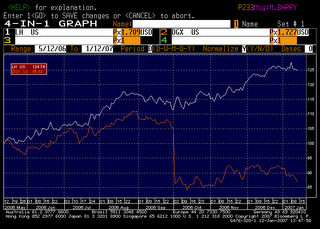
The chart indicates the approximate gain, although the ride has been a bit more volatile than I had expected when i got into the trade. The original thesis was that DGX was 25% undervalued versus Labcorp, but Quest lost a second major contract (following UNH loss) that made me question their aggressiveness in their core lab business. As originally predicted, Quest Diagnostics picked its skirt up from around its ankles and got back to work, with the recent announcement that LH would no longer be serving as Aetna's in-network lab provider.
This helps Quest marginally, but more importantly signals the potential for a major price war, which could hurt both companies longer term (fighting for market share, cutting each others throats). Quest will probably still be a good long-term investment at these levels, but I have decided to speculate a bit and close out both sides of the trade. Net-net, I exited DGX around a 1/2% loss, and LH at a 7.5% gain. I'm sure the trade levels will continue to collapse, but will look to re-enter DGX within the next month or two hopefully.

The chart indicates the approximate gain, although the ride has been a bit more volatile than I had expected when i got into the trade. The original thesis was that DGX was 25% undervalued versus Labcorp, but Quest lost a second major contract (following UNH loss) that made me question their aggressiveness in their core lab business. As originally predicted, Quest Diagnostics picked its skirt up from around its ankles and got back to work, with the recent announcement that LH would no longer be serving as Aetna's in-network lab provider.
This helps Quest marginally, but more importantly signals the potential for a major price war, which could hurt both companies longer term (fighting for market share, cutting each others throats). Quest will probably still be a good long-term investment at these levels, but I have decided to speculate a bit and close out both sides of the trade. Net-net, I exited DGX around a 1/2% loss, and LH at a 7.5% gain. I'm sure the trade levels will continue to collapse, but will look to re-enter DGX within the next month or two hopefully.

Sunday, February 25, 2007
Another Day, Another buyout... for those not keeping track at home, Florida Rock and Hydril have both been bought out at massive premiums versus my recommendations (to buy) that were made within the past six months in this blog. FRK is trading at $68 (up 58% from my $43 reco. price in Oct. 2006 and 78% from my buy-in price) and HYDL is trading at $95 (up 86% from my $51 buy-in price). They have been bought at heavy premiums above what the public market value would have reached, but reflective of the control premium that a private owner would be willing to pay to acquire these high quality franchises. Unfortunately, I unloaded most of my stock in both names after I had made 25% and 41% in the respective names. I have had more annoying problems in my life than selling at a 40% gain within a one month period though!
I continue to like $2-5Bln market cap companies, but have lately been looking at some slightly larger entities that also represent high quality businesses with strong brands and franchise quality. Several of these names are trading just above levels where I would consider them to be cheap. For instance, SAIC(federal IT/professional-services contractor-$18.50) and MRH(Bermuda reinsurance-$17.70) are names that I like. SAIC's main business risk is political, in the form of potential Democratic meddling with Federal outsourcing.... MRH's is hurricanes and nonsense like Florida's restructuring of its excess-of-loss reinsurance pricing.
In spite of these risks, MRH is increasing its book value by 15-20%/year and trades at 1.1x book value, with one of the best underwriters as its CEO and a more conservative risk policy (which is why book value isnt going up even faster). SAIC is not "cheap" per se, on an earnings basis, given its nearly 20x forward earnings, but this is one of those beauties that earns more in free-cashflow than it reports in earnings, due to the amortization of fixed-contract costs that are incurred up-front. Given that nearly 22,000 of their 45,000 employees have high-level security clearances (tough to acquire), this gives them a reasonable barrier to entry. On a FCF basis SAI earns above a 5% yield and should improve this figure now that it is a public company. On both companies I have bought a small amount of stock and sold out of the money calls. In addition, I have sold $17.50 puts going out to April for a 3% implied yield-to-put (22% annualized return, assuming I am not put any stock). If either SAI/MRH falls below $17.50 I would be okay owning these entities for the long-term, based on my current view of management and the companies.
I do not think either of these companies will be acquired by private equity, although SAI would be extremely attractive in an LBO if it were to fall much below $17.50....so I am not expecting a grand slam like FRK/HYDL to occur. The market appears frothy with too many things hitting 52 week highs, companies that people were shunning back in July. (PS- If I am not "put" any MRH/SAI, would look to roll and sell forward additional contracts, although MRH should carry a huge premium through the summer if you think hurricane season migh pick up).
I continue to like $2-5Bln market cap companies, but have lately been looking at some slightly larger entities that also represent high quality businesses with strong brands and franchise quality. Several of these names are trading just above levels where I would consider them to be cheap. For instance, SAIC(federal IT/professional-services contractor-$18.50) and MRH(Bermuda reinsurance-$17.70) are names that I like. SAIC's main business risk is political, in the form of potential Democratic meddling with Federal outsourcing.... MRH's is hurricanes and nonsense like Florida's restructuring of its excess-of-loss reinsurance pricing.
In spite of these risks, MRH is increasing its book value by 15-20%/year and trades at 1.1x book value, with one of the best underwriters as its CEO and a more conservative risk policy (which is why book value isnt going up even faster). SAIC is not "cheap" per se, on an earnings basis, given its nearly 20x forward earnings, but this is one of those beauties that earns more in free-cashflow than it reports in earnings, due to the amortization of fixed-contract costs that are incurred up-front. Given that nearly 22,000 of their 45,000 employees have high-level security clearances (tough to acquire), this gives them a reasonable barrier to entry. On a FCF basis SAI earns above a 5% yield and should improve this figure now that it is a public company. On both companies I have bought a small amount of stock and sold out of the money calls. In addition, I have sold $17.50 puts going out to April for a 3% implied yield-to-put (22% annualized return, assuming I am not put any stock). If either SAI/MRH falls below $17.50 I would be okay owning these entities for the long-term, based on my current view of management and the companies.
I do not think either of these companies will be acquired by private equity, although SAI would be extremely attractive in an LBO if it were to fall much below $17.50....so I am not expecting a grand slam like FRK/HYDL to occur. The market appears frothy with too many things hitting 52 week highs, companies that people were shunning back in July. (PS- If I am not "put" any MRH/SAI, would look to roll and sell forward additional contracts, although MRH should carry a huge premium through the summer if you think hurricane season migh pick up).
Wednesday, February 07, 2007
Site of the Month- Check out http://valuediscipline.blogspot.com/
They had a pretty good writeup several days ago on MMM. From what I can tell, this company generates nearly $4.5Bln in normalized cashflow from operations, approximately $3.5Bln actual cashflow (due to working capital expenses) and nets out to $2.5Bln actual free cashflow per year. This assumes continued R&D and growth expenditures, however on lower growth assumptions this company trades at 16x free-cashflow in a low growth scenario, for a 6.25% free cashflow yield. While not the sexiest yield in the world, people have historically paid a lot more for this company's earnings...which have continued to increase in the face of a flattish/declining stock price over the past few years. The chart below tracks the company's stock price (white line) vs. its P/E (green line). MMM is under-levered ("AA" credit rating) and appears to be somewhat cheap on an absolute basis, but very cheap on a relative basis (versus its historical trading range). It is difficult to gauge competitive threats and how much LCD pricing will hurt some of their film divisions, so I am just buying a half position and watching it. This is more of a long-term IRA stock.

Friday, January 12, 2007
Quest For The Championship? Although the Bears playoff game on Sunday is probably the Quest most sane people are focused on, I have noticed a disturbing discrepancy between Quest Diagnostics(DGX) and Laboratory Corp.(LH) valuations. The discrepancy has arisen from LH bidding aggressively on DGX contracts. Both companies run diagnostic lab/testing facilities and are the largest players in their industry. Vital stats are below. 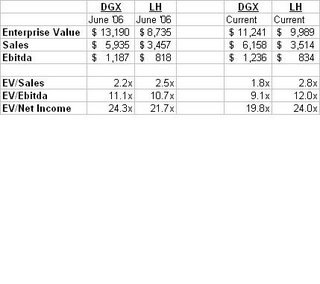
For similar businesses in a commoditized industry (in which DGX is the leader and has historically outperformed LH in) Laboratory Corp is trading at a higher sales multiple (55% premium) and a higher Ebitda multiple (33%). The fact that Laboratory Corp is willing to sacrifice margins and risk its own book of business to engage in a price war does not appear to be priced into the market. Given that Quest is likely to engage in similar guerilla-type market-share theft, I believe a short of Laboratory Corp. makes sense. At the same time, I like the overall industry and believe Quest Diagnostics is trading at a 'slighly' compelling valuation that could be attractive to a private equity buyer (particularly if it fell any further.
As such, I am recommending a short of LH ($73) and a buy of DGX ($50.10) and have executed this trade for myself and my Oceans-7 account. I am considering selling LH $75 calls and/or buying longer-dated $65 LH puts. Below is a historical spread comparison between the two companies. Note that since 1995, DGX has significantly outperformed LH (in spite of recent drop), which tends to indicate that DGX's near-term underperformance may revert towards the historical average. I have not done any mean-regression analysis, apart from what I can accomplish by eye-balling the chart. This looks like a winner though, as I think the market is reading too much into DGX's loss of a contract with United Healthcare (which accounted for 7% of DGX revenue). The thesis behind the trade idea is, if DGX is in trouble....LH will be too in the not-too-distant future. This has been true for both companies historically.
For similar businesses in a commoditized industry (in which DGX is the leader and has historically outperformed LH in) Laboratory Corp is trading at a higher sales multiple (55% premium) and a higher Ebitda multiple (33%). The fact that Laboratory Corp is willing to sacrifice margins and risk its own book of business to engage in a price war does not appear to be priced into the market. Given that Quest is likely to engage in similar guerilla-type market-share theft, I believe a short of Laboratory Corp. makes sense. At the same time, I like the overall industry and believe Quest Diagnostics is trading at a 'slighly' compelling valuation that could be attractive to a private equity buyer (particularly if it fell any further.
As such, I am recommending a short of LH ($73) and a buy of DGX ($50.10) and have executed this trade for myself and my Oceans-7 account. I am considering selling LH $75 calls and/or buying longer-dated $65 LH puts. Below is a historical spread comparison between the two companies. Note that since 1995, DGX has significantly outperformed LH (in spite of recent drop), which tends to indicate that DGX's near-term underperformance may revert towards the historical average. I have not done any mean-regression analysis, apart from what I can accomplish by eye-balling the chart. This looks like a winner though, as I think the market is reading too much into DGX's loss of a contract with United Healthcare (which accounted for 7% of DGX revenue). The thesis behind the trade idea is, if DGX is in trouble....LH will be too in the not-too-distant future. This has been true for both companies historically.
Subscribe to:
Posts (Atom)